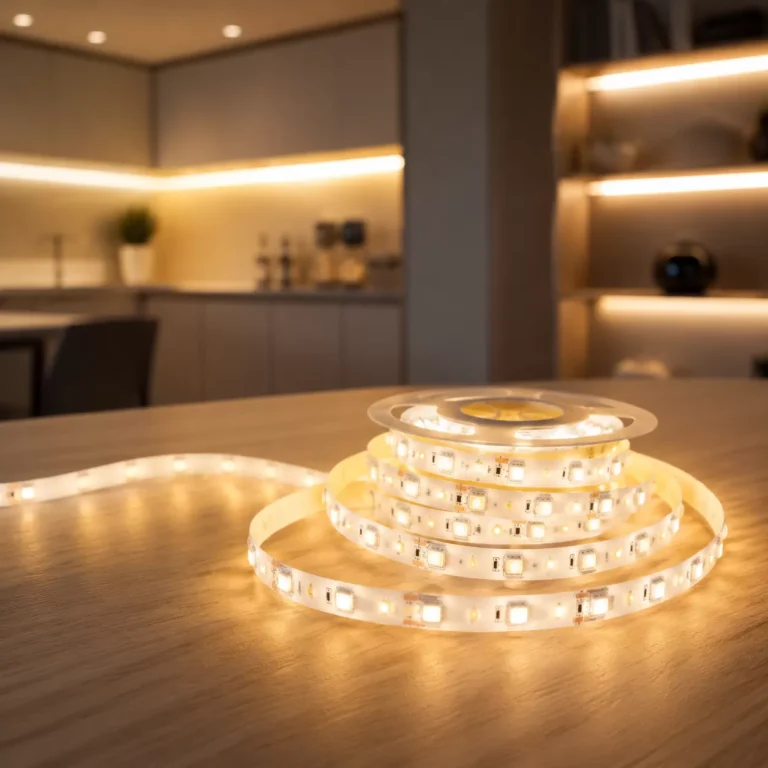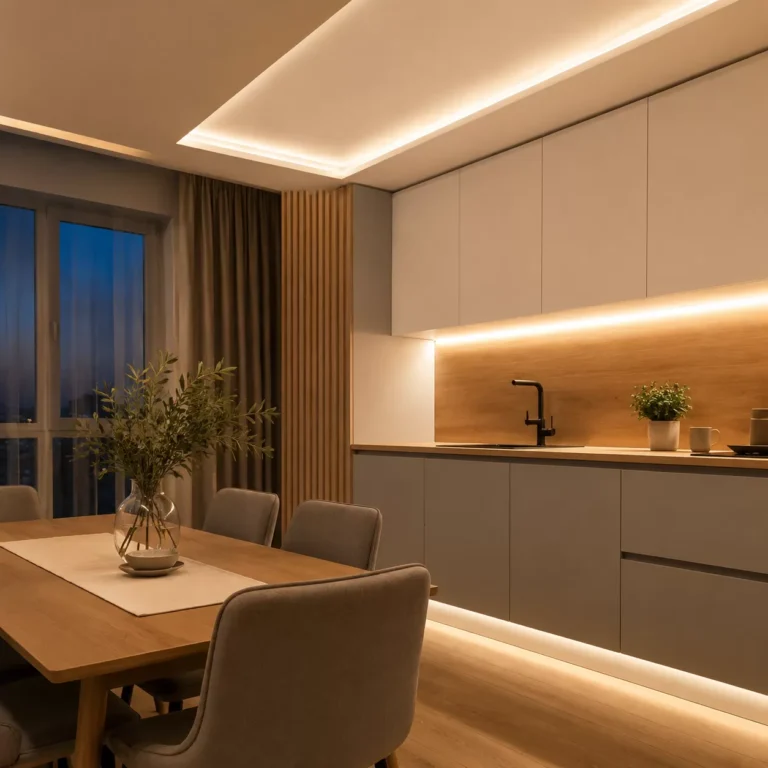
What Distinguishes a Smart LED Strip from Standard Tape Light?
A standard tape light operates as a passive electrical load: apply DC voltage, and every diode on the circuit illuminates at the same intensity and color. A smart LED strip, by contrast, is an intelligent networked endpoint. It integrates onboard integrated circuits (ICs), microcontrollers, and wireless transceivers to interpret digital commands directly at the trace or diode level.
+——————+ Digital Logic Signal +—————————————–+
| Microcontroller | —————————–> | Smart LED Strip |
| & Wireless Radio | | [IC + Diode] -> [IC + Diode] -> […] |
+——————+ +—————————————–+
The Architecture: Analog Tape vs. Intelligent Linear Systems
In traditional linear lighting, dimming or color mixing depends on external analog wall dimmers or inline PWM modules altering voltage across the entire cut run. Modern smart strip systems replace this blunt approach with microprocessor-driven logic.
| Feature | Standard Analog Tape Light | Smart LED Strip Light |
|---|---|---|
| Control Signal | Uniform voltage variance (PWM / 0–10V) | High-speed digital serial data + PWM |
| Circuit Design | Resistor + LED diode arrays | Microcontrollers, digital driver ICs, and diode packages |
| Zoning Capability | Entire continuous run acts as a single zone | Multi-zone segmentation or individual pixel control |
| System Connectivity | Hardwired manual switches / wall dimmers | Wi-Fi, Zigbee, Thread/Matter, BLE, or SPI/DMX |
| Operational Logic | Static ON/OFF and fixed color output | Automated scenes, schedules, and adaptive brightness |
Key Advantages of Smart Linear Lighting
Integrating microcontrollers and digital logic directly into the tape light architecture unlocks critical operational benefits for modern installations:
- Circadian Rhythm Automation: Automatically tracks natural daylight cycles, shifting from crisp 6500K cool white during peak daytime hours to warm, low-blue 2700K tones in the evening to support biological sleep cycles.
- Dynamic Scene Scheduling: Executes scheduled lighting changes based on time of day, occupancy sensors, or specific events without requiring manual intervention.
- Multi-Zone & Pixel Mapping: Addressable ICs allow individual sections or single diodes along one continuous ribbon to display distinct colors, directional chases, or localized task illumination.
- Native Smart Home Ecosystem Integration: Connects directly with control ecosystems such as Matter, Apple Home, Google Home, Amazon Alexa, and Home Assistant for synchronized, whole-building automation.
Understanding Diode Types, Density, and Form Factors
The performance of any smart LED strip comes down to its physical diode package, circuit density, and color mixing layout. Choosing the correct form factor determines whether your installation yields smooth, uniform glow or uneven, spotted light.
SMD vs. COB: Choosing the Right LED Package
- Traditional SMD (Surface-Mount Device): Packages like SMD2835 and SMD5050 mount discrete diodes along the circuit board. While cost-effective and capable of high lumen outputs, lower-density SMD configurations can produce visible “hotspots” unless installed in deep aluminum profiles with heavy diffusers.
- COB (Chip-on-Board): Modern COB LED strip tape places hundreds of micro-chips directly onto the flexible PCB under a continuous phosphor layer. This achieves spotless, dot-free linear light with ultra-wide 180° beam angles, even in ultra-shallow mounting channels.
| Feature | SMD Smart Tape | COB Smart Tape |
|---|---|---|
| Diode Density | Typically 60–120 LEDs/m | Up to 480–840 chips/m |
| Hotspot Risk | Visible in shallow profiles | Virtually zero / seamless beam |
| Beam Angle | ~120° | ~180° |
| Primary Use | High-output indirect coves | Direct-view joinery and architectural details |
Color Spectrum Architecture
Smart linear lighting requires matching the right diode channels to your project’s functional demands:
- Monochrome: Single-color or static Kelvin output, engineered purely for dimmable accent or task lighting.
- Tunable White (CCT): Dual-channel diodes (ranging from 2700K warm amber to 6500K cool daylight) designed for circadian rhythm automation and biologically supportive lighting.
- RGB: Basic 3-channel dynamic color mixing for entertainment and decorative accents.
- RGBW: Integrates a dedicated white diode (3000K or 4000K) alongside RGB channels to eliminate muddy pastel tones and deliver clean task lighting.
- RGBCCT (5-in-1): The professional standard. Combines full-spectrum RGB color mixing with independent dual-channel tunable white on a single RGB LED strip platform, allowing full saturation adjustments and crisp architectural whites simultaneously.
Digital Pixel Control: RGBIC and Addressable ICs
Standard analog strips change the entire run to one uniform color. In contrast, an addressable RGBIC LED strip incorporates micro-integrated circuits (such as external WS2811 or built-in SK6812 chips) directly into the tape.
This enables individual diode or segment-level control across data lines. With addressable ICs, you can program complex dynamic scenes, chase sequences, multi-zone color zoning, and fluid gradient transitions across a single continuous strip.
Color Quality Metrics: High CRI and Binning
Accurate color rendition is non-negotiable in architectural and residential applications. We look at two primary standards:
- High CRI Metrics: High-fidelity smart tape should maintain Ra ≥ 90 with an R9 value ≥ 50, ensuring saturated reds, natural skin tones, and rich wood grain rendering.
- MacAdam Ellipse Binning: Strict 3-step SDCM (Standard Deviation of Color Matching) binning guarantees that diode Kelvin temperatures and chromaticity remain identical from reel to reel, preventing mismatched color patches across linked runs.
Smart Connectivity Protocols Compared
Choosing the right communication protocol dictates whether a smart LED strip system runs seamlessly or suffers from lag, dropped connections, and frustrating setup headaches. When engineering a smart lighting system, we match the protocol directly to the installation scale and control ecosystem.
+——————-+——————–+————————+———————–+
| Protocol | Network Topology | Best For | Hub Required? |
+——————-+——————–+————————+———————–+
| Wi-Fi (2.4 GHz) | Star (Direct) | Small, standalone jobs | No |
| Zigbee 3.0 | Mesh | Multi-room / Whole-home| Yes (Zigbee Gateway) |
| Matter over Thread| Mesh | Multi-ecosystem setups | Yes (Thread Router) |
| BLE (Bluetooth) | Point-to-Point | Single-room proximity | No (Local only) |
| DMX / SPI / MQTT | Hardwired / Local | Pro architectural sync | Yes (Dedicated bridge)|
+——————-+——————–+————————+———————–+
Wi-Fi (2.4 GHz): Standalone Simplicity
Wi-Fi remains the most common entry point for consumers and simple retrofits.
- Direct connection: Communicates straight to your standard 2.4 GHz home router without buying an extra bridge.
- Bandwidth & congestion: Every strip claims an IP address. Once you load 20 to 30 Wi-Fi IoT devices onto a standard residential router, bandwidth saturation causes command delays and random dropouts.
- Best use: Single-room accent runs, desk setups, and standalone feature lighting where ecosystem scale is limited.
Zigbee 3.0: Low-Latency Mesh Networking
For reliable, multi-zone control across an entire property, a Zigbee 3.0 LED controller setup is our primary recommendation.
- Self-healing mesh: Each mains-powered smart controller acts as a repeater, expanding the signal range across floors and thick walls.
- Instant response: Ultra-low latency transmission ensures zero perceptible delay between flipping a switch and lighting up the strip.
- Low traffic footprint: Keeps lighting commands off your primary Wi-Fi network, preserving router bandwidth.
- Hub dependency: Requires a compatible Zigbee coordinator or gateway (such as Philips Hue, Hubitat, or SmartThings).
Matter over Thread: Unified Cross-Platform Control
A Matter compatible light strip running over a Thread network bridges ecosystem silos without proprietary cloud bridges.
- Native cross-platform execution: Simultaneously pairs with Apple Home, Google Home, Amazon Alexa, and Samsung SmartThings.
- Local speed: Operates entirely over a local, low-power Thread mesh network, preventing cloud outages from taking down your lighting.
- Border router integration: Devices like Apple TV 4K, HomePod Mini, or Nest Hub serve as border routers, making commissioning seamless.
Bluetooth Low Energy (BLE): Local Proximity Control
BLE strips focus on simplicity and offline performance.
- Instant setup: Fast pairing directly with a smartphone app without typing in Wi-Fi passwords.
- Range limits: Control drops off past 30 feet (10 meters) line-of-sight.
- No native out-of-home control: Requires an auxiliary Bluetooth-to-Wi-Fi gateway if remote access is required.
Direct Integration: Home Assistant, MQTT, and DMX/SPI
For architectural installations and local automation enthusiasts, standard consumer apps fall short.
- Home Assistant & MQTT: Deploying controllers flashed with open firmware (like WLED or ESPHome) provides 100% local, subscription-free control with sub-millisecond UDP syncing.
- Professional DMX512 and SPI: High-density pixel tape requires hardwired SPI (Data/Clock) lines or DMX decoders to achieve 60 FPS video-syncing, live stage effects, and smooth, flicker-free commercial automation.
If you are sourcing complete architectural runs with pre-paired drivers and custom protocols, our team at the LED strip factory OEM/ODM wholesale manufacturer configures fully integrated, protocol-ready linear lighting packages to your project specifications.
Power Delivery, Voltage Selection, and Driver Calculations
When configuring a high-performance smart LED strip setup, reliable power delivery is the foundation of system stability. Undersized drivers or improper voltage planning lead to thermal stress, erratic controller behavior, and visible performance drops.
5V vs. 12V vs. 24V DC Systems
Choosing the operating voltage dictates your run lengths and thermal efficiency:
- 5V DC: Common in short, high-density digital pixel runs (like USB-powered displays). It carries high current over short distances, making it prone to severe resistance losses.
- 12V DC: Suitable for short-to-medium runs up to 5 meters. Better current handling than 5V, but still vulnerable to line resistance on extended circuits.
- 24V DC: The industry standard for professional 24V DC smart strip lighting. Operating at 24V cuts current draw in half compared to 12V for the same wattage (P = V × I), significantly reducing heat buildup in the copper traces and doubling reliable run lengths before needing extra power feeds. As a dedicated LED strip manufacturer, we engineer commercial linear systems around 24V DC architectures to maximize diode lifespan and maintain consistent output.
+———+——————+——————+———————–+
| Voltage | Current Load | Thermal Build-up | Max Direct Run Length |
+———+——————+——————+———————–+
| 5V DC | Very High | High | ~2 to 3 meters |
| 12V DC | Moderate | Moderate | ~5 meters |
| 24V DC | Low (Optimized) | Minimal | ~10 meters |
+———+——————+——————+———————–+
Mitigating Voltage Drop
Voltage drop occurs when copper trace resistance reduces the voltage reaching distant LEDs.
- Symptoms: Noticeable dimming toward the end of a run, flickering, and severe color shifting (such as pure white turning pinkish or yellowish due to the voltage sag on blue and green diodes).
- Parallel Wiring: Run dedicated home-run DC cables from the power source directly to each separate strip section instead of daisy-chaining end-to-end.
- Voltage Drop Power Injection: Inject supplementary 24V/12V power at the tail end or every 5 to 10 meters along extended runs while maintaining a shared ground across the installation.
- Ring Topology: Connect both the start and the end of the LED strip back to the same power supply terminals to equalize pressure across the circuit.
Sizing the Power Supply Unit (PSU)
Never run a LED driver at 100% continuous capacity. To prevent thermal shutdown and component degradation, apply an 80% continuous load rule (a 20% safety margin headroom):
$Minimum PSU Wattage (W) = (Rated Watts per Meter × Total Length in Meters) × 1.20$
Example: A 10-meter installation rated at 14.4 W/m requires 144 W × 1.20 = 172.8 W. A standard 200W constant-voltage 24V driver is the correct specification.
PWM Frequency and Flicker-Free Smart Dimming
Smart controllers modulate brightness using Pulse Width Modulation (PWM). Selecting the right controller parameters ensures optimal visual performance:
- Flicker-Free Output: Opt for smart dimming hardware operating at high PWM frequencies (ge 4 kHz to 20 kHz) to eliminate visible stroboscopic effects and prevent rolling lines on video recordings or security cameras.
- Logarithmic Dimming Curves: Human eyes perceive brightness changes logarithmically rather than linearly. High-grade smart LED dimming protocols utilize logarithmic dimming curves to deliver smooth, ultra-deep fading without stepping or abrupt cutoffs below 5% output.
Durability, Thermal Management, and IP Ratings
Heat is the primary enemy of any smart LED strip. Packed with onboard microcontrollers, addressable ICs, and high-output diodes, smart strips generate concentrated thermal loads. Without proper heat dissipation, junction temperatures rise rapidly, leading to color shift, phosphor degradation, and early diode failure.
Aluminum Channels for Heat Sinking and Optical Diffusion
We always install smart tape light within dedicated aluminum extrusions. A quality LED aluminum profile diffuser addresses three critical engineering requirements:
- Thermal conduction: Aluminum draws heat away from the copper PCB traces, keeping operating temperatures low and maintaining diode lumen output over extended runs.
- Beam smoothing: Frosted or opal diffusers blend distinct diode hotspots into a smooth, spotless neon-like glow across walls and reflective surfaces.
- Mechanical protection: The rigid channel shields the bare circuit board, ICs, and solder joints from dust, moisture, and accidental physical impacts during cleaning or maintenance.
Ingress Protection (IP) Guide for Smart Strips
Selecting the correct Ingress Protection rating prevents electrical shorts, corrosion, and moisture damage across different project environments:
- IP20 (Indoor Dry): Bare PCB design for dry, enclosed indoor locations like ceiling coves, shelving, and joinery. It provides optimal passive thermal dissipation directly against the mounting substrate.
- IP65 (Splash-Resistant): Protected by a top-surface silicone coating. This IP65 waterproof smart strip format resists steam, accidental splashes, and dust, making it the standard choice for kitchen under-cabinet runs and bathroom vanity accents.
- IP67 / IP68 (Encapsulated & Submersible): Housed in solid silicone extrusions or potted sleeves to withstand continuous outdoor weather, driving rain, and temporary submersion. For exterior perimeter lighting requiring dynamic color without visible spotting, an outdoor-rated neon LED strip delivers seamless environmental protection.
Review our full linear lighting product lineup to pair your installation with the correct extrusion profile and IP-rated smart strip configuration.
Best Practices for Clean, Long-Lasting Smart Strip Installation
A flawless smart LED strip installation comes down to careful planning, clean connections, and stable data flow. Setting up these systems properly ensures your smart lighting runs reliably for years without flickering, peeling, or signal dropouts.
1. Layout Planning and Cable Routing
Before mounting anything, map out your full power and signal runs:
Identify Cut Points: Check the designated copper pads. Standard strips allow cuts every 2 to 4 inches, while addressable pixel strips must be cut strictly along marked boundaries to keep IC circuits intact.
Locate the Hardware: Hide your power supply unit (PSU) and smart controller in accessible, ventilated areas like access panels, cabinet false bottoms, or drop ceilings.
Verify Signal Direction: Addressable strips are directional. Always orient the data line arrows (DI to DO) away from the controller toward the end of the run.
[24V PSU] ──> [Smart Controller] ──(Data + Power)──> [ Strip IN -> -> -> Strip OUT ]
2. Surface Preparation and Secure Adhesion
Smart strips generate baseline heat that can soften cheap adhesives. Ensuring a clean mechanical bond prevents sagging:
Degrease the Surface: Clean mounting channels with 70%+ isopropyl alcohol to eliminate dust, grease, and mill oils.
Use Industrial Adhesive: We equip our commercial-grade strips with high-tack 3M VHB thermal backing tape for continuous thermal transfer and grip.
Add Mechanical Fasteners: Use silicone mounting clips every 18 to 24 inches for inverted or vertical runs to prevent corner lifting over time.
3. Cutting, Splicing, and Preserving Data Continuity
Clean connections are essential for uninterrupted data flow and color accuracy:
Direct Soldering (Recommended): Soldering wires directly to the copper pads ensures zero resistance, prevents voltage bottlenecks, and eliminates intermittent data drops on addressable setups.
Solderless Connectors: If using snap connectors, choose transparent, insulation-displacement (piercing) connectors rated for your specific PCB width and trace thickness.
Data Line Shielding: Keep controller-to-strip data jumpers under 5 meters (16 feet) or use a data signal amplifier to stop high-frequency signal degradation. Explore detailed LED strip knowledge and wiring practices for deeper technical references on complex layouts.
4. Controller Pairing and System Commissioning
Once the hardware is secured, commission the system through your smart automation platform:
Channel Calibration: Match the controller’s output sequence to your tape light (e.g., swapping RGB to GRB or BRG in software if red outputs as green).
Network Binding: Pair the controller to your 2.4 GHz Wi-Fi, Zigbee hub, or Matter mesh network close to the router before final installation.
Power-On Behavior: Set default power-loss recovery states in your app to ensure the smart tape returns to a soft warm white or stays off after utility outages.
Implementing Smart LED Strips Across Diverse Spaces
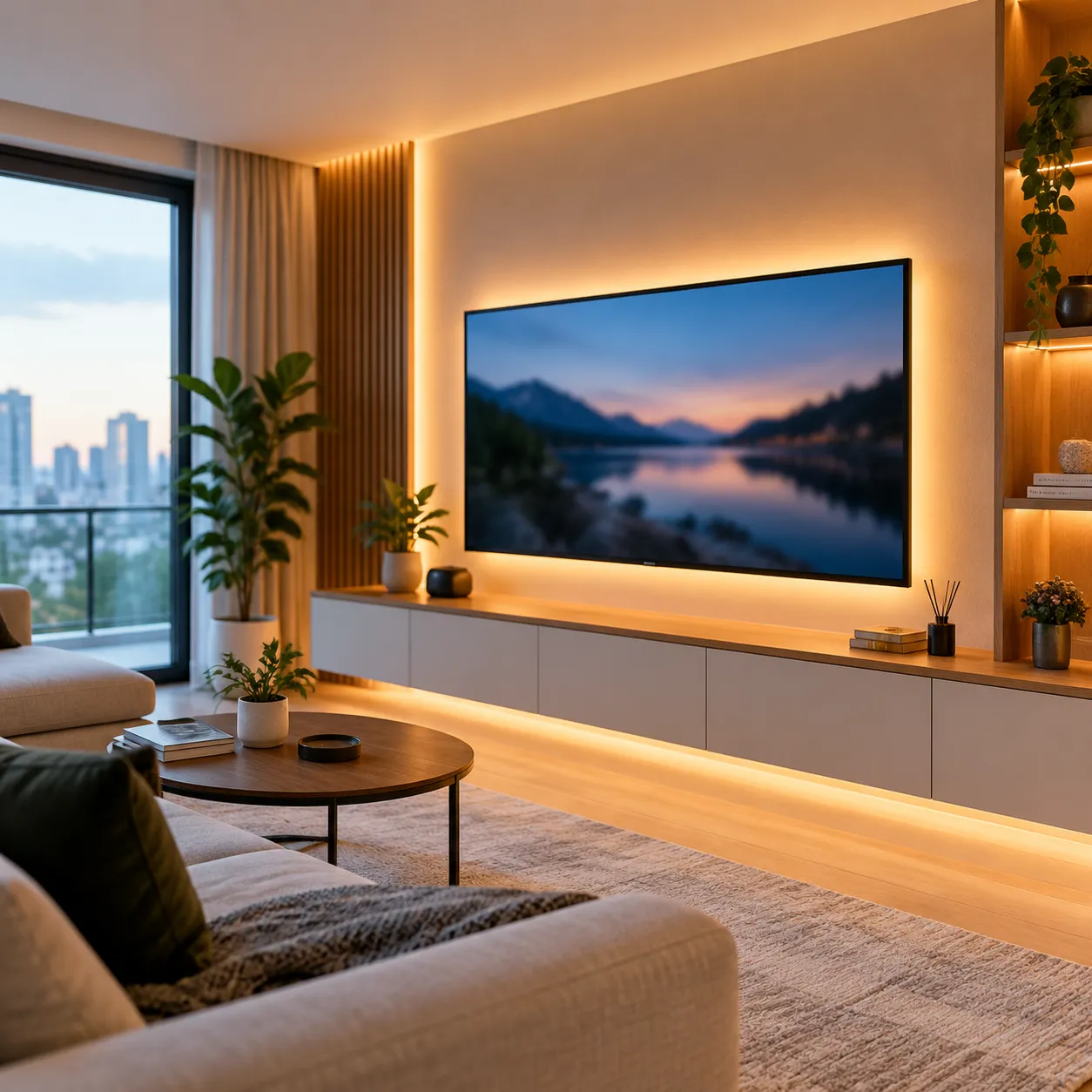
When we design and deploy linear smart lighting systems, the hardware selection must match the physical environment and the control requirements. A single type of smart LED strip does not fit every zone. Here is how we apply different strip configurations across architectural, commercial, and entertainment spaces to maximize both visual performance and automated control.
Architectural Cove and Indirect Ceiling Lighting
Indirect cove lighting demands smooth, seamless illumination without visible hot spots or diode breaks. We use 24V DC smart strip lighting with wide beam angles bounced off matte ceiling recesses to create clean floating ceiling effects.
- Circadian Rhythm Automation: Using RGBCCT tunable white tape light allows automated transitions from crisp 6500K daylight white for morning focus down to warm 2700K amber tones in the evening.
- Continuous Long Runs: Indirect perimeters often require run lengths exceeding 10 meters. Using 24V tape paired with dual-end power delivery prevents visible dimming or color shifting across room borders.
Cabinet and Joinery Lighting
Under-cabinet and architectural millwork require high optical clarity and ultra-low diode visibility due to reflective surfaces like quartz and polished stone.
- Task Lighting with High Color Accuracy: We specify high CRI smart tape light (Ra ≥ 90) under kitchen cabinets and workbenches so food, surfaces, and materials display their true colors.
- Spotless Finishes: A COB smart LED strip installed within a shallow slimline profile delivers a completely uniform, neon-like beam with zero diode imaging on glossy countertops.
- Motion-Activated Night Routing: Integrating strips with low-voltage PIR sensors through smart home lighting automation enables automated 10% brightness pathway illumination during late-night hours.
Commercial and Hospitality Venues
Bars, hotel reception areas, and retail displays require durable, highly adaptable accent lighting that can transition smoothly between day and night service.
| Application Zone | Recommended Strip Type | Key Functional Benefit |
|---|---|---|
| Bar Counters & Kickplates | IP65 RGBCCT Smart Strip | Splash protection with dynamic ambient color scenes |
| Retail Display Shelving | High-Density Tunable White COB | Eliminates shadows and highlights merchandise details |
| Hotel Reception & Lobbies | 24V Addressable / DMX-Linked Strip | Centralized schedule control for shifting day-to-night ambiance |
Entertainment and Gaming Environments
In media rooms and gaming setups, fast refresh rates and localized multi-zone color control take priority over static ambient white light.
- Addressable RGBIC LED Strip Integration: Individual IC-controlled pixels enable dynamic zone-chasing effects, smooth ambient gradients, and localized backlighting behind consoles and battlestations.
- Screen and Audio Synchronization: Low-latency smart controllers map display colors directly to perimeter strips in real time, expanding the perceived visual field and reducing eye strain during high-contrast scenes.
Diagnostic Guide for Smart LED Strip Failures
Even high-grade smart strip installations can run into field issues during setup or daily operation. When a system misbehaves, we use this systematic troubleshooting workflow to isolate and resolve electrical, signal, and protocol faults quickly.
Strip Displays Wrong Colors or Inverted Channels
- The Problem: Selecting red in your smart app turns the strip green, or cold white appears warm.
- The Root Cause: Incorrect color channel mapping in the controller firmware or mismatched pinout wiring on analog/hybrid setups.
- The Fix:
- Analog Strips: Check the controller terminal blocks. Ensure the labeled leads (+, R, G, B, W, CCT) match the physical copper pads on the PCB exactly.
- Addressable RGBIC Strips: Open your controller setup menu (such as WLED or your native ecosystem app) and toggle the Color Order setting. Switch the sequence between RGB, GRB, or BRG until the physical diodes match the onscreen color picker.
Connectivity Drops and Delayed Response
- The Problem: The smart LED strip shows as “Offline” or takes several seconds to execute automation triggers.
- The Root Cause: 2.4 GHz Wi-Fi channel congestion, RF shielding inside metal enclosures, or an incomplete Zigbee mesh topology.
- The Fix:
- Wi-Fi Controllers: Assign your smart controllers to a dedicated 2.4 GHz IoT VLAN. Lock the channel on your wireless access point to 1, 6, or 11 to prevent auto-hopping interference.
- Zigbee 3.0 Systems: Place an AC-powered Zigbee repeater (such as a smart plug or in-wall relay) halfway between the coordinator hub and the strip controller to eliminate dead zones.
- Signal Path: Never mount wireless controllers entirely inside sealed metal junction boxes without an external antenna.
Diode Flickering and Driver Buzzing
| Symptom | Primary Cause | Solution |
|---|---|---|
| Rapid strobing at low brightness | Low PWM frequency mismatch | Increase the controller PWM frequency above 1 kHz or switch to a constant-current dimming module. |
| High-pitched whine from PSU | Driver overloaded past capacity | Upsize the power supply unit to maintain a 20% continuous load safety headroom. |
| Intermittent full-strip flashing | Loose common ground | Tighten all terminal screws and verify that DC negative (V-) connections share a common reference point. |
Dark or Frozen Sections on Addressable Strips
- The Problem: The first few feet of an addressable tape light run normally, but the rest of the strip stays completely black or freezes on a single static color.
- The Root Cause: A damaged integrated circuit (IC), a fractured PCB trace, or a cold solder joint along the digital data line (DATA/DIN).
- The Fix:
- Identify the Fault Point: Locate the transition between the last illuminated diode and the first non-functional pixel. The fault resides in either the Data Out (DOUT) of the working pixel or the Data In (DIN) of the dead pixel.
- Verify Data Direction: Ensure the strip is wired along the directional data arrows printed on the PCB (DIN $to$ DOUT).
- Cut and Splice: Power down the system, cut out the defective segment at the designated copper cut points, and solder a fresh segment into place, ensuring clean continuity across +V, GND, and DATA.
Engineering Quality and Customization with LNLED
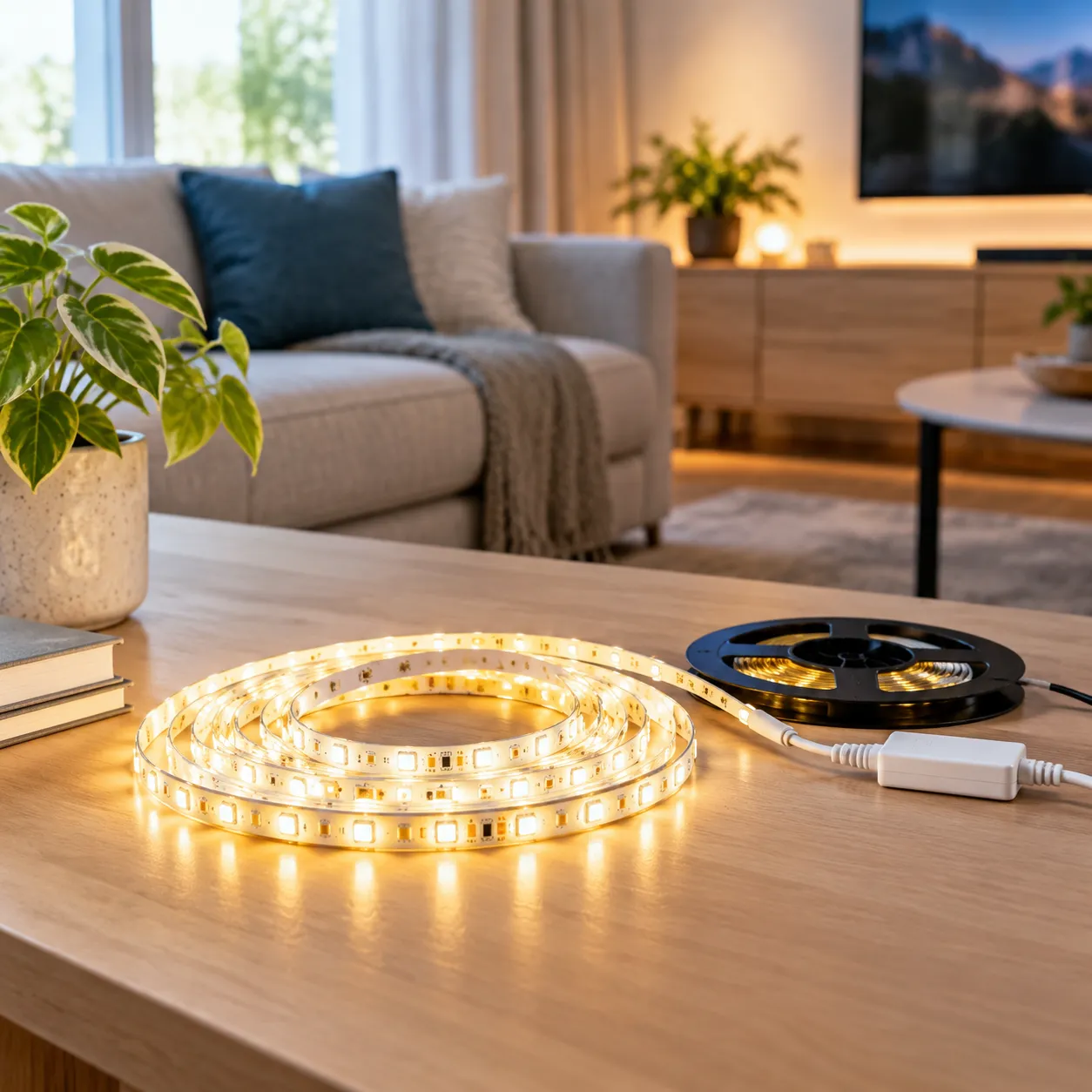
Standard off-the-shelf tape lights often fail in commercial environments due to loose binning tolerances, thin copper traces, and thermal throttling. At LNLED, we engineer our smart LED strip systems from the raw substrate up to eliminate color shifts, reduce line loss, and ensure seamless system integration for large-scale deployments.
Diode Binning and Batch Consistency
Color mismatch between separate production runs ruins clean architectural lines. We eliminate visible Kelvin variation through strict quality controls:
- Single-Bin Sourcing: All diodes are sorted within a 3-step MacAdam ellipse (SDCM ≤ 3), guaranteeing unnoticeable color divergence across thousands of meters.
- Targeted Spectral Output: High CRI values (Ra ≥ 90 / R9 ≥ 50) ensure accurate color rendering across tunable white (2700K–6500K) and RGBCCT configurations.
- Batch-to-Batch Uniformity: Repeat orders for replacement runs or multi-phase projects match existing installations seamlessly.
Heavy-Duty 2oz and 3oz Double-Layer Copper PCBs
The foundation of a reliable smart LED strip is its printed circuit board. We construct our flexible linear systems using premium 2oz and 3oz rolled annealed copper substrates.
| Engineering Parameter | Standard Tape Light | LNLED Smart LED Strip |
|---|---|---|
| Copper Weight | 1oz single-layer | 2oz / 3oz double-layer copper |
| Electrical Resistance | High (Causes rapid voltage drop) | Ultra-low line resistance |
| Thermal Dissipation | Traps heat at diode junction | Rapid heat transfer away from ICs |
| Mechanical Strength | Fragile trace cracking on corners | High tensile strength and bend resilience |
[ Diode & IC Heat Generation ]
│
▼
┌───────────────────────────────┐
│ 2oz / 3oz Copper Layer 1 │ ◄── Rapid lateral thermal spread
├───────────────────────────────┤
│ Dielectric Core Layer │
├───────────────────────────────┤
│ 2oz / 3oz Copper Layer 2 │ ◄── Direct heat sinking to substrate
└───────────────────────────────┘
Full-Scale OEM and ODM Customization
Every architectural project and commercial build has distinct physical and electrical constraints. We deliver fully customized linear smart lighting hardware ready for direct site installation:
- Custom Lengths and Terminations: Factory-cut segments with pre-soldered, IP-rated waterproof quick-connect leads to minimize on-site labor.
- High-Density COB Form Factors: Dot-free, seamless illumination engineered directly into smart addressable and tunable white profiles.
- Tailored Kelvin and Spectrum Profiles: Specialized dynamic CCT ranges, ultra-warm 1800K dimming curves, or task-specific commercial spectra.
- Matched Control Gear: Custom-packaged drivers, smart controllers, and power delivery hardware built to exact voltage and protocol requirements.
Smart LED Strip FAQs
Here are direct, field-tested answers to the most common questions we encounter when designing, installing, and configuring smart LED strip setups.
| Question | Quick Answer | Key Technical Factor |
|---|---|---|
| Can I cut anywhere? | No, only on marked cut pads | Cutting elsewhere severs PCB traces and IC data lines |
| Work with wall dimmers? | No, requires constant DC voltage | AC phase-cut dimmers starve the onboard microcontroller |
| Behavior after power loss? | Configurable via controller memory | Retains last state, turns off, or resets to default safe mode |
| Max run without injection? | 5m (12V) / 10m (24V 2oz copper) | Prevents resistive voltage drop and color shifting |
| Multi-room simultaneous control? | Yes, via app/ecosystem grouping | Handled via Matter, Zigbee mesh, or local network groups |
Can I cut a smart LED strip anywhere, or only at marked cut lines?
You must cut smart LED tape light strictly across the designated copper solder pads.
- Circuit Continuity: Cutting between the marked lines severs the internal copper traces and disables all diodes in that segment.
- Addressable Chips: On pixel or addressable strips, each cut mark aligns precisely with individual driver IC boundaries (such as WS2811 or SK6812). Cutting through an IC trace permanently damages the data channel down the rest of the run.
Do smart LED strips work with traditional wall dimmer switches?
No. Standard AC wall dimmers (TRIAC, leading-edge, or trailing-edge) are incompatible with smart linear lighting systems.
- Constant Power Requirement: Smart LED strip controllers, Wi-Fi radios, and microcontrollers require uninterrupted, constant DC voltage (12V or 24V DC) to stay online and communicate.
- Failure Symptoms: Feeding a smart power supply with a chopped AC waveform causes continuous device reboots, rapid flickering, lost network binding, and premature driver failure. All dimming must be handled natively via Pulse Width Modulation (PWM) through the smart app, voice commands, or wireless protocol controllers.
What happens to my smart strip settings if the power goes out?
Modern smart controllers store operational parameters in non-volatile flash memory, but behavior depends on your power-on state configuration:
- Last State Memory: The controller resumes its exact brightness, color spectrum, and scene settings from before the outage.
- Default Warm/Safe Mode: Automatically powers on to 100% warm white (2700K–3000K) so the strip can serve as standard functional lighting in an emergency.
- Always Off: Remains powered down until explicitly triggered by a schedule, motion sensor, or smart home app command.
What is the maximum continuous run length for a smart LED strip without power injection?
The safe continuous run length depends directly on system voltage and PCB copper thickness:
- 5V DC Systems: Maximum 2 to 3 meters before severe voltage drop and data instability occur.
- 12V DC Systems: Maximum 5 meters (16.4 ft) on standard boards.
- 24V DC Systems: Up to 10 meters (32.8 ft) when using heavy-duty 2oz or 3oz double-layer copper PCBs.
Running distances beyond these limits leads to noticeable lumen reduction and pinkish color shift at the tail end. For longer linear architecture, we always implement parallel runs or dedicated power injection loops every 5 to 10 meters.
Can I control multiple smart LED strips simultaneously across different rooms?
Yes. Multi-zone and whole-home synchronization are standard across modern smart home lighting automation platforms:
- Ecosystem Grouping: Group independent controllers inside platforms like Home Assistant, Apple Home, Google Home, or Amazon Alexa to execute single-tap scene changes.
- Zigbee 3.0 & Matter Mesh: Devices communicate across a unified local mesh network, eliminating latency and ensuring perfectly synchronized dimming and color transitions across separate rooms without bogging down your home Wi-Fi bandwidth.