Are you struggling to choose between a 12V vs 24V LED strip for your next project?
Pick the wrong voltage, and you’ll quickly run into uneven brightness, wasted money, and frustrating voltage drop.
The good news? Deciding between the two is actually simple once you understand how they perform in the real world.
In this guide, I’ll break down the core electrical differences, show you how to calculate your maximum run length, and reveal why 24V has become the go-to standard for commercial installations—so you can power your project with complete confidence.
Let’s dive right in.
Core Electrical Difference Between 12V and 24V
Understanding the electrical relationship between voltage, current, and power is essential when evaluating a 12V vs 24V LED strip setup. Power consumption follows a basic electrical rule:
Power (Watts) = Voltage (Volts) × Current (Amps)
For any given power load, doubling the operating voltage cuts the required electrical current in half. Because a 24V LED system operates at half the amperage of a 12V system delivering identical wattage, it significantly reduces internal resistance and heat buildup across the copper circuit traces.
Technical Comparison: 12V vs 24V Strip Architecture
| Electrical Parameter | 12V LED Strip | 24V LED Strip |
|---|---|---|
| Current (Amps) at Equal Power | 2x higher current | 50% lower current |
| Resistance Loss (Heat) | Higher thermal load on PCB | Lower thermal load on PCB |
| Circuit Design | Typically 3 LEDs per circuit group | Typically 6 LEDs per circuit group |
| Cut Length Intervals | Shorter intervals (tighter precision) | Longer intervals (standard spacing) |
| Power Conductor Demand | Requires thicker copper traces | Operates efficiently on standard traces |
Key Electrical Takeaways
- Current Load: Lower current in 24V systems minimizes strain on power supplies, connectors, and solder joints.
- Trace Efficiency: 24V circuits experience less thermal stress, resulting in improved operating stability over continuous operational cycles.
- Circuit Segmentation: 12V strips group LEDs in smaller series sets, offering shorter cutting increments, whereas 24V strips group more diodes per segment to optimize overall electrical throughput.
Voltage Drop Performance: Maximum Run Length Comparison
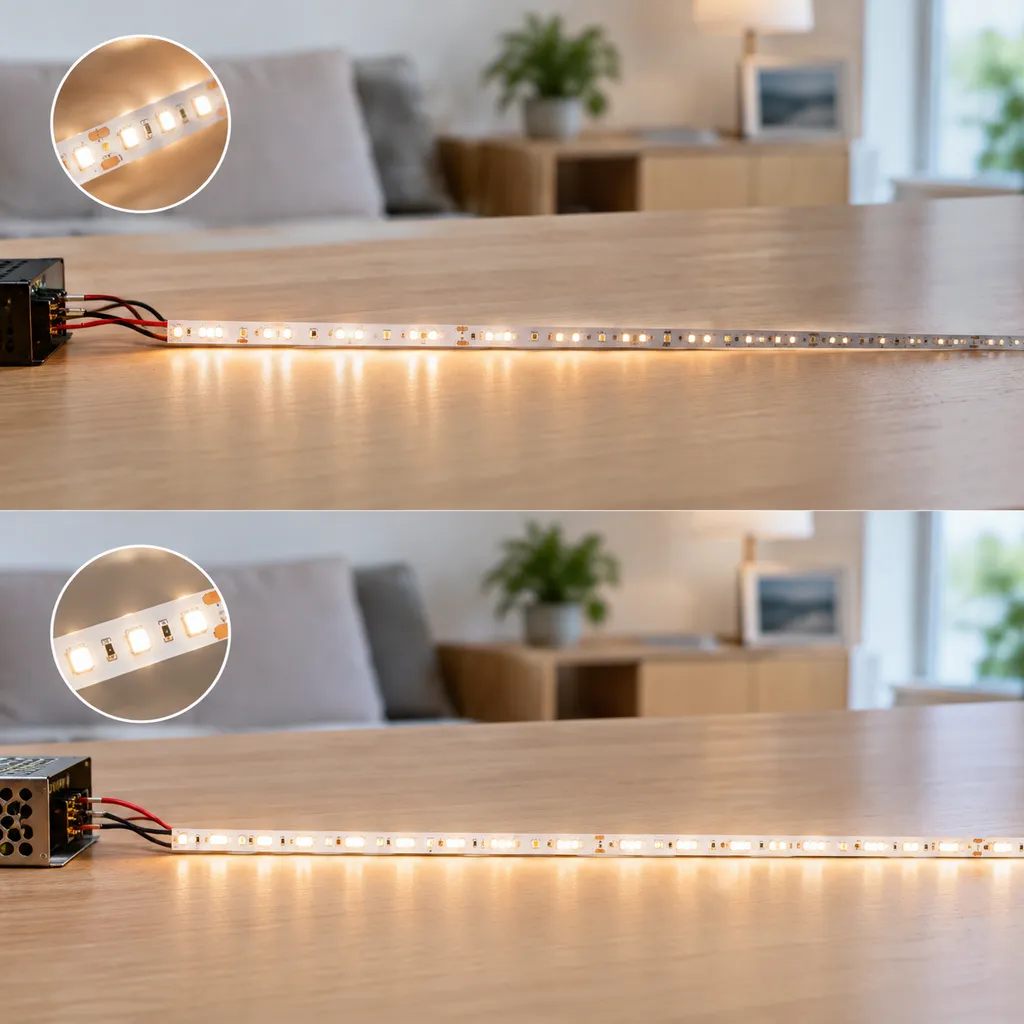
Voltage drop happens when electrical resistance along the circuit board weakens power as it travels further down the line. In practical terms, your tape starts bright at the power feed and visibly fades toward the tail end. When evaluating a 12V vs 24V LED strip, understanding voltage drop is the single most critical factor in planning continuous runs without noticeable dimming.
12V vs 24V LED Strip: How to Choose the Right Voltage for Long Runs
Because 24V circuits draw half the amperage of 12V setups at identical wattage, they generate significantly less trace resistance over distance. This allows 24V systems to power roughly twice the continuous length of a 12V run before experiencing noticeable light loss. For installations relying on a high lumen LED strip bright energy efficient lighting setup, minimizing voltage drop ensures consistent lumen output and uniform color temperature from end to end.
| Feature | 12V LED Strip | 24V LED Strip |
|---|---|---|
| Voltage Drop Sensitivity | High (current is doubled) | Low (current is halved) |
| Continuous Single-Feed Run | Shorter standard distances | Extended continuous runs |
| Power Injections Needed | Frequent to prevent tail dimming | Infrequent for standard layouts |
| Circuit Heat Accumulation | Higher trace heat per watt | Lower trace heat per watt |
Key Run Length Principles
- Single-Feed Limitations: Powering a 12V strip from one end leads to visible color shift and dimming much earlier than on a 24V run.
- Fewer Wiring Points: 24V strips eliminate the need for parallel power feeds and extra drop wiring across medium to long spans.
- Uniform Brightness: Lower current through 24V boards keeps diodes operating at balanced brightness across the entire installation.
Application Scenarios for 12V LED Strips
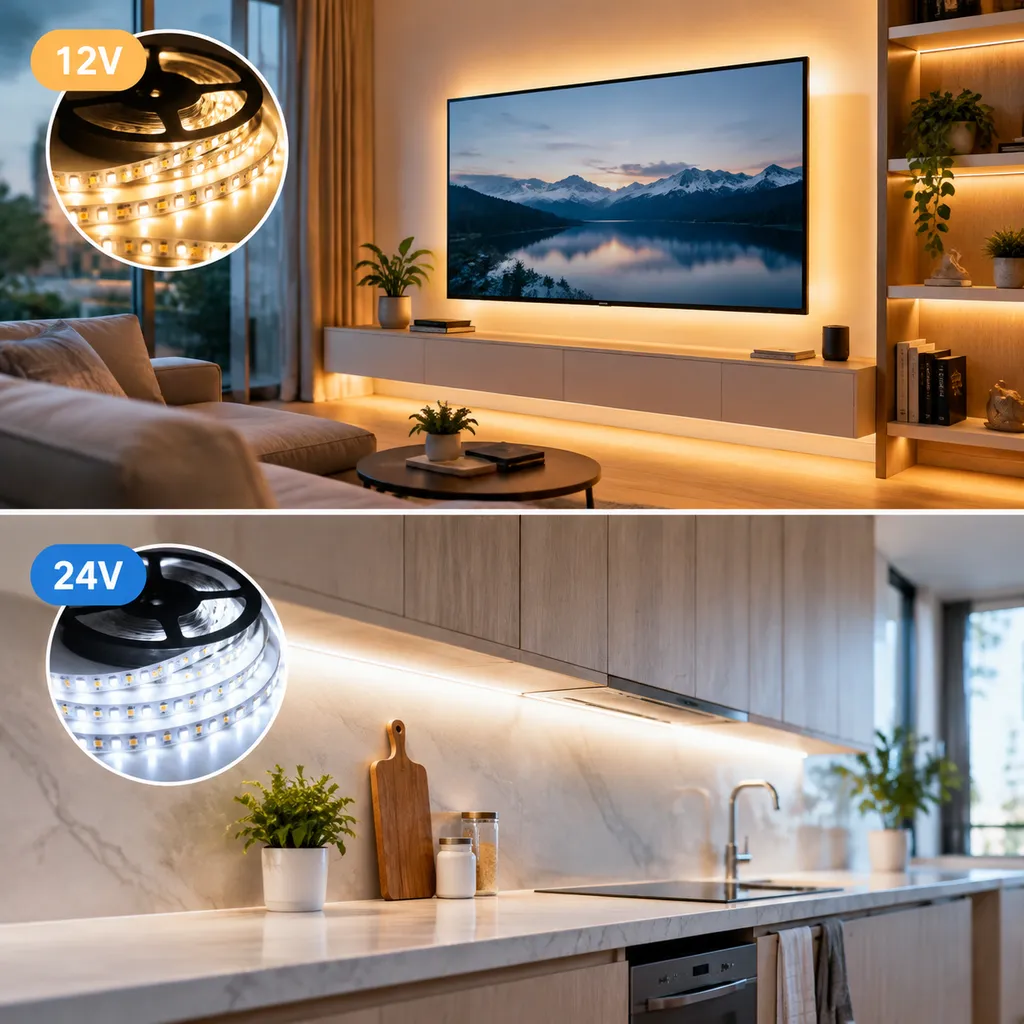
When evaluating a 12V vs 24V LED strip, voltage selection directly shapes your project outcome. We find that 12V LED strips remain the go-to solution for compact installations, vehicle electrical systems, and targeted task lighting where flexibility and precise sizing matter most.
Automotive, RV, and Marine Systems
Direct compatibility is the primary benefit here. Most cars, boats, campervans, and utility trailers operate natively on a 12V DC electrical architecture. Using a 12V strip allows direct wiring to the vehicle’s electrical circuit without needing a step-down buck converter, reducing installation complexity and eliminating conversion energy loss.
Battery-Powered and Off-Grid Builds
For portable displays, trade show exhibits, or mobile workstations, a 12V configuration is straightforward to deploy. If your setup involves powering LED strip lights using batteries, standard 12V lithium or sealed lead-acid battery packs connect directly to the strip, minimizing the hardware you need to carry.
Tight-Space Display and Cabinet Lighting
Short cut points give 12V strips a distinct advantage in custom cabinetry and retail display cases:
Shorter cut increments: Typically cuttable every 1 to 2 inches (2.5 to 5 cm), allowing precise edge-to-edge fit inside narrow spaces.
Under-cabinet niches: Fits exact kitchen counter lengths without leaving dark corners or folding excess tape.
Accent and shelving details: Ideal for backlighting small shelves, monitors, and custom trade fixtures where total run lengths stay well under 16 feet (5 meters).
Application Scenarios for 24V LED Strips

When managing large installations or extended layouts, choosing a 24V configuration delivers the consistency required for clean, professional results. Deciding between a 12V vs 24V LED strip comes down to layout distance, power stability, and overall project scale.
Extended Architectural and Perimeter Runs
For perimeter cove lighting, hallway baseboards, and expansive ceiling drops, 24V systems operate over longer continuous distances from a single power feed. The higher operating voltage handles resistance better across the circuit, keeping light output uniform from the start of the strip to the end.
Commercial and Retail Installations
In offices, retail stores, and hospitality venues, lighting runs often stretch across dozens of meters. As a dedicated LED strip manufacturer, we design 24V platforms specifically to reduce wiring complexity and cut down the total number of power injection points required throughout large facilities.
Seamless High-Density Lighting
For premium finishes without visible diode hotspots, modern installations frequently pair 24V drivers with high-density tape. Integrating a 24V COB LED strip provides:
- Uniform Illumination: Steady current distribution prevents dimming over extended spans.
- Reduced Cable Clutter: Fewer power supplies and drop feeds simplify hidden ceiling or cabinet layouts.
- Thermal Balance: Lower operating current reduces heat buildup across the copper traces, supporting longer component life.
Step-by-Step: Calculate Max Run Length for Your Project
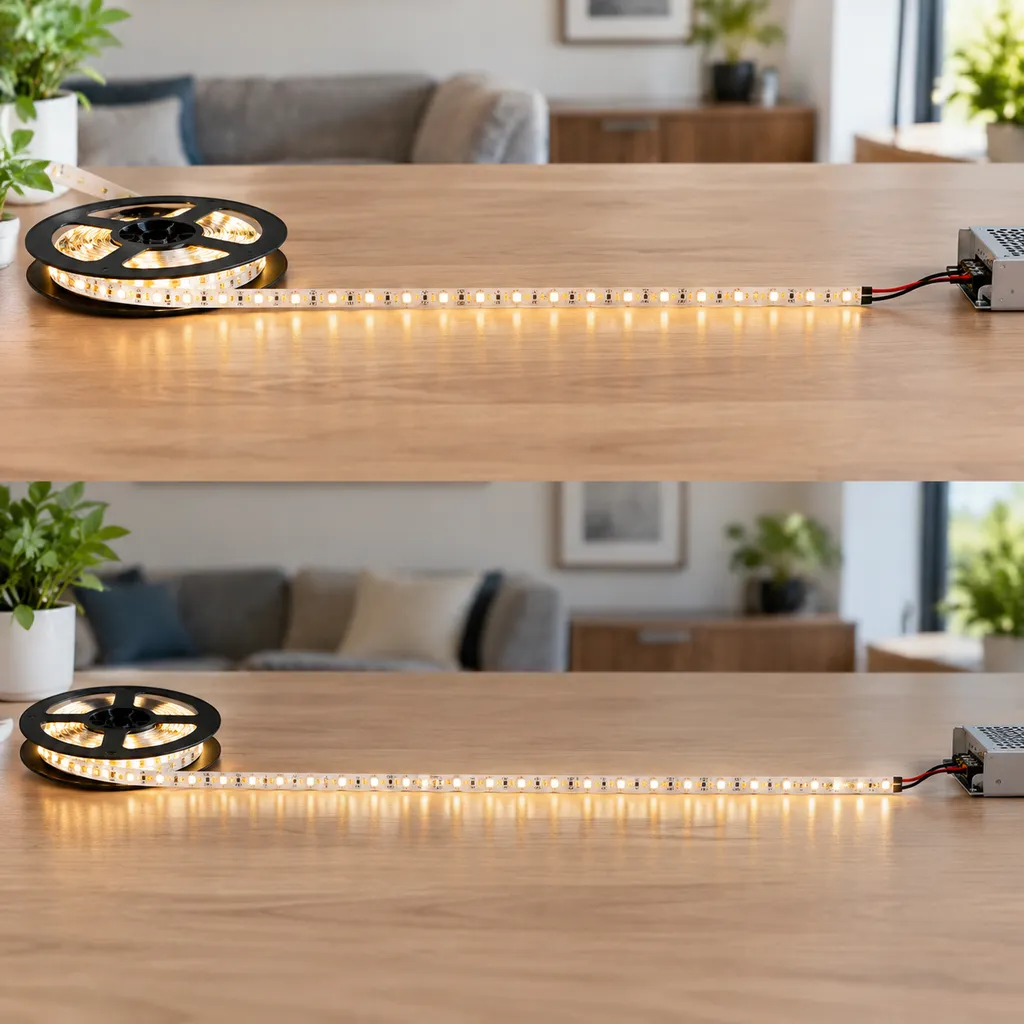
When comparing a 12V vs 24V LED strip, calculating the maximum run length is the best way to prevent voltage drop and keep your brightness consistent from start to finish. When evaluating 12V vs 24V LED Strip: How to Choose the Right Voltage for Long Runs, use this straightforward process to size your layout accurately:
Step 1: Identify Rated Power Consumption
Check the manufacturer specifications for the rated wattage per meter or foot. High-output runs or multi-channel setups like an RGB LED strip draw significantly more power per linear meter than standard accent tape, which directly impacts how far the current can travel before dimming occurs.
Step 2: Establish the Single-Feed Distance Limit
Every strip circuit has a threshold where resistance in the copper traces causes visible voltage drop:
12V Systems: Deliver stable illumination across shorter continuous segments before requiring a new power feed.
24V Systems: Carry current at half the amperage of 12V for the same wattage, allowing double the continuous run distance on a single power connection without color shifting. This makes 24V especially effective for dense options like a seamless COB LED strip.
Step 3: Calculate Total Circuit Wattage
Multiply the length of your strip by its rated power draw:
Total Watts = Length (meters) × Rated Watts per Meter
Step 4: Apply the 80% Power Supply Safety Buffer
Never load a driver to 100% capacity. Add a 20% headroom margin to extend driver lifespan and prevent premature dimming:
Minimum Driver Capacity = Total Watts × 1.2
Quick Run Length Reference Guide
| Voltage | Typical Max Single-Feed Run | Recommended Use Case | Wiring Strategy |
|---|---|---|---|
| 12V | Shorter runs (up to 5m standard) | Vehicles, tight cabinetry, short accents | Single-end feed |
| 24V | Extended runs (up to 10m standard) | Architectural coves, long perimeter runs | Single-end or dual-end feed |
Following these steps ensures your run stays within safe electrical tolerances while delivering uniform output across your entire installation.
Why 24V Is Standard for Commercial Projects
When evaluating a 12V vs 24V LED strip setup for large installations, 24V systems consistently serve as the industry baseline for commercial environments. Architectural lighting, hospitality venues, and retail spaces demand uniform illumination over extended distances without excessive power feed points.
Key Commercial Advantages
- Extended Continuous Runs: Higher operating voltage cuts current draw in half for the same wattage, reducing voltage drop and keeping brightness uniform from start to finish.
- Simplified Wiring Infrastructure: Fewer power supply injection points mean reduced copper wire gauge requirements, lower material costs, and faster installation times.
- Power Supply Efficiency: Running higher-voltage drivers reduces heat generation and allows commercial drivers to operate closer to peak efficiency.
- Versatile Form Factors: Architectural designs often pair these systems with specialty fixtures like a high-efficiency neon LED strip to achieve continuous, dot-free ambient lines without voltage decay.
| Commercial Factor | 12V LED Strip | 24V LED Strip |
|---|---|---|
| Current Draw | Higher (increased resistance loss) | 50% lower current draw |
| Power Feed Frequency | Feeds required every 5 meters | Feeds spaced up to 10 meters or more |
| Labor & Materials | Higher wire and connection costs | Optimized wiring and lower installation costs |
| Thermal Load | Higher heat on PCB traces | Lower operating heat on conductors |
Selecting 24V architecture ensures commercial installations stay reliable, maintain balance across extended runs, and simplify long-term maintenance across any full lighting product layout.